
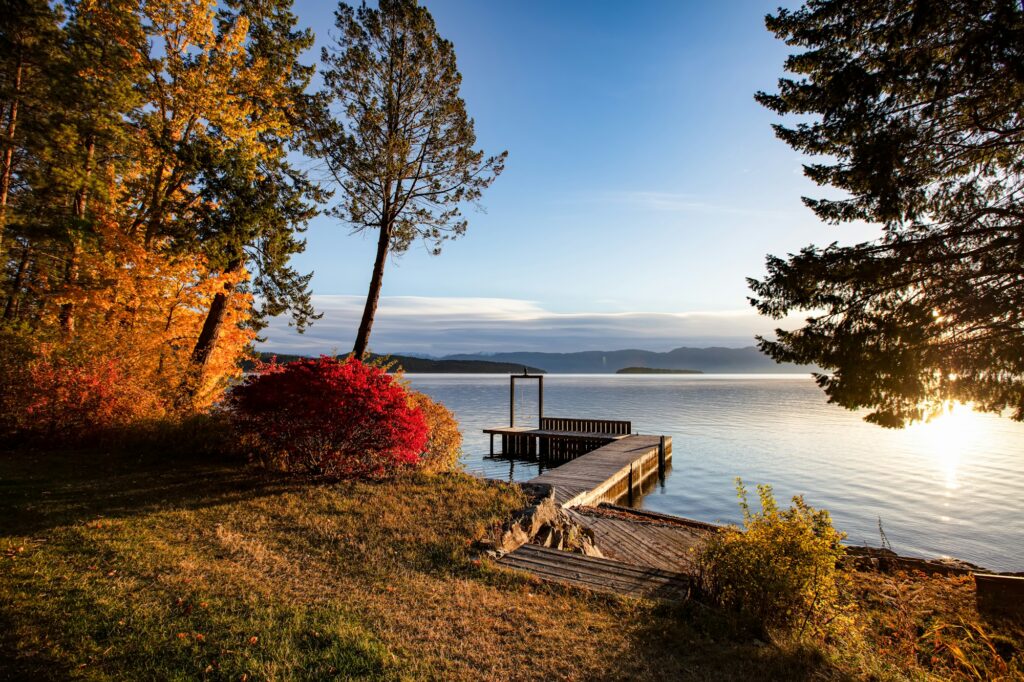
Representative stock image. Photo by Bill Stephan on Unsplash.
When family visits your cabin, they may know where the coffee mugs are but not where the shoreline drops off. A friend arriving after dark may head straight down the steps to the dock. Children may see the swimming raft before anyone has talked about how they will use it.
For Minnesota lakeshore owners, a guest plan should extend all the way to the water. Walking that route also gives you a practical way to review liability coverage with your insurance agent.
Walk the waterfront as a new guest
Start at the cabin door and follow the path people actually take. Look at steps, handrails, lighting, uneven ground and the transition onto the dock. Check for loose boards, slippery surfaces, exposed hardware and a ladder that is difficult to use. Keep a written repair list and address hazards before inviting people to use the area.
Explain what a visitor cannot easily see: changing water depth, submerged obstacles, boat traffic and where swimming is allowed. Give guests a clear rule against diving from the dock or raft. Decide how to keep people out of the boat-boarding space while others are swimming.
For children, the DNR recommends wearing a life jacket near water, including on docks, and emphasizes that life jackets do not replace adult supervision. Have parents check fit before the weekend rather than discovering at the shoreline that the available jackets are the wrong size. Minnesota DNR child life jacket guidance
Agree on a specific supervising adult and an explicit handoff when that person changes. A group of adults nearby is not a clear supervision arrangement. Show everyone where emergency equipment and the property address are kept, and make sure someone can describe access from the road.
Review the swimming raft as its own amenity
A raft deserves a separate conversation from the dock. Review its condition, anchoring, access ladder, intended use and location with the appropriate installer or service provider. Ask your insurer about eligibility requirements before adding a platform, slide or other waterfront feature.
Also verify permits. The DNR says temporary structures that do not extend from shore, including swimming rafts, require a county sheriff's permit if left in the water between sunset and sunrise. Even daytime placement must not obstruct navigation or create a hazard. DNR public-waters requirements and local controls are separate considerations. Minnesota DNR dock and raft permit guidance
Tell your agent whether the raft is yours, shared with a neighbor or part of an association's waterfront. Bring photos showing its relationship to your dock and swimming access. A permitted installation still needs an insurance review; a permit does not establish coverage.
Match cabin liability and umbrella coverage to the setting
An injury and a claim of legal responsibility are not the same insurance question. Minnesota Commerce explains that homeowners personal liability coverage addresses claims for bodily injury or damage to someone else's property, subject to the policy. Ask how your actual cabin policy applies to the waterfront and what exclusions matter. Minnesota Commerce homeowners coverage guide
Use concrete examples: a visitor falls on the dock, someone is injured using the swimming raft, or a guest moves from swimming to riding in the boat. Ask which policy would be reviewed for each situation, including any separate watercraft policy. Medical-payments provisions should be discussed separately from liability coverage, rather than assuming every guest medical bill is insured.
Then coordinate any umbrella. The Travelers Institute explains that umbrella coverage is considered after underlying coverage is exhausted and that required underlying liability limits may apply. Ask your agent to check the cabin location, ownership, boat policies, required limits and relevant exclusions together. An umbrella should not be treated as an automatic repair for an excluded or uninsured waterfront activity. Travelers Institute Insurance Essentials, umbrella section
Use a short checklist before guests arrive
Before the next gathering:
- Repair or close off unsafe paths, dock sections and equipment.
- Explain swimming boundaries, no-diving rules and boat-boarding procedures.
- Confirm children's jacket fit and the adult supervision plan.
- Review the raft's condition, location and permit status.
- Share the address, emergency access information and equipment locations.
- Give your agent updated waterfront photos and a list of amenities.
Keep the explanation welcoming and specific. Guests should know how to enjoy the lake without having to guess how your waterfront works.
To discuss your cabin, dock and swimming area together, contact David Olson at Intrinsic Insurance, 952-314-9446. Coverage and eligibility depend on policy language, endorsements and underwriting; a review should establish what applies to your property, not assume every activity is included.

 One of the things that sets Intrinsic Insurance apart is our commitment to our customers. We believe that insurance should be easy to understand and easy to use, and we strive to make the process as smooth and stress-free as possible. Our agents take the time to get to know our customers and their unique needs, so we can provide personalized coverage that meets their specific requirements. Over time, we’ve earned a reputation for exceptional customer service and expertise in the insurance industry, real estate, and construction. We’re proud to have a team of experienced agents who are dedicated to providing our customers with the highest level of service and support. Our agents are knowledgeable, friendly, and always available to answer questions or help our customers file a claim.